


Somebody asks what you would do if you never had to work again, and the honest answer is usually a shrug. Not because the question is silly, but because nobody has ever told you what the number is. So it stays a daydream, filed next to winning the lottery, and you go back to the invoice you were chasing.
It is not a daydream. It is a division problem. You can do it in about forty seconds, and the arithmetic is the easy half — the useful part is what the number assumes, and which of those assumptions are currently being argued about by the people who invented them.
The one-line version
Take what you spend in a year. Divide it by a withdrawal rate. That is your number.
At 4%, dividing by 0.04 is the same as multiplying by 25 — which is where “25 times your annual spending” comes from. Spend $60,000 a year and the number is $1,500,000. Spend $120,000 and it is $3,000,000.
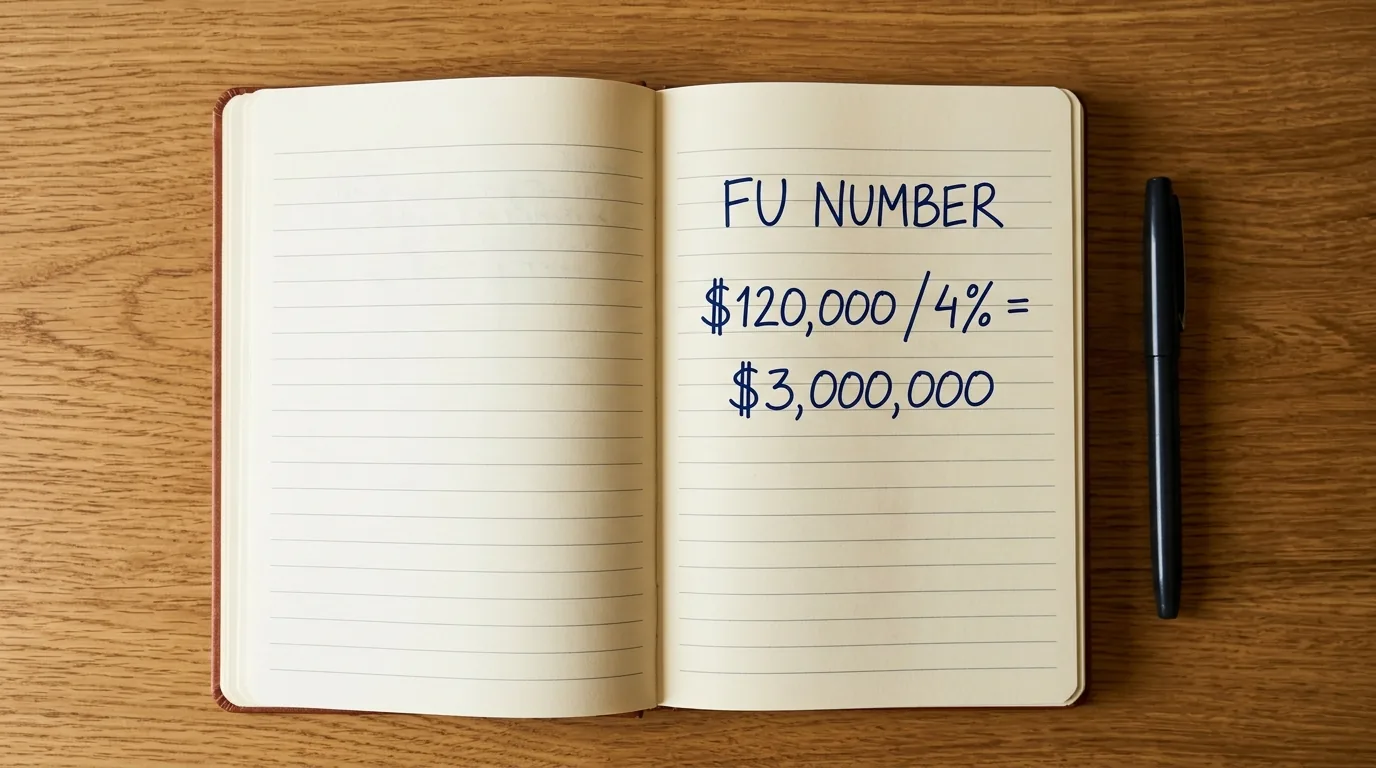
That is the whole calculation. Every other page on this subject stops here. The next three sections are the reason you should not.
Why the multiple is contested in 2026
The 4% rule comes from William Bengen, who published it in 1994 after testing withdrawal rates against every thirty-year window in the historical record. The Trinity Study, three professors at Trinity University, broadly confirmed it in 1998. The number stuck so hard that most people now treat it as a law of nature.
It is not. And in 2026 the two most-cited sources disagree with each other by a wide margin.
Morningstar’s 2026 base case is 3.9%. That comes from its 2025 annual report, the most recent, up from 3.7% in the one before, and it describes a portfolio holding 30–50% equities with the rest in bonds and cash, modeled to have roughly a 90% chance of lasting a thirty-year retirement. Their figure has moved with every report — 3.3% in the 2021 report, 3.8% in 2022, 4.0% in 2023, 3.7% in 2024 and 3.9% in 2025 — which tells you something in itself.
Bengen’s own current number is 4.7%. In A Richer Retirement, published in August 2025, the man who created the rule raised his own figure, having widened the test portfolio to seven asset classes at roughly 55% stocks, 40% bonds and 5% cash. He calls 4.7% a cautious starting point rather than a hard rule.
Put those on the same spending number and look at what happens. On $120,000 a year:
- at 3.9% — $3,076,923
- at 4.0% — $3,000,000
- at 4.7% — $2,553,191
The gap between the top and the bottom of that list is about $523,700. Same year, same question, two credible sources, and half a million dollars of daylight between them. At a $60,000 savings rate that difference is nearly nine years of your life.
So the number is a range, not a figure. Anyone who hands you one number to two decimal places is giving you confidence they have not earned. Run yours at all three rates and treat the spread as the honest answer.
Work out your number
Two inputs. The second one matters more than almost anybody tells you, which is the next section.
Work out your own number
Nothing is sent anywhere — this runs in your browser and stores nothing.
Your FU number
$3,000,000
$120,000 a year — $10,000 a month — drawn at 4.0%.
- Lean — essentials only, 70% of spending $2,100,000
- FU — your spending as it is now $3,000,000
- Full — the life you’d choose, 130% $3,900,000
- Cutting $100 a month lowers it by $30,000
The line item that breaks early retirement
If you are self-employed you already buy your own health coverage, so you may think retiring changes nothing here. It changes one thing: your income drops, and in the United States the cost of that coverage is tied to your income.
And 2026 is a bad year to be modeling it. The enhanced ACA premium tax credits expired at the end of 2025. The Kaiser Family Foundation projected that, without them, the average annual premium paid by subsidized enrollees would go from $888 in 2025 to $1,904 in 2026 — more than double, for the same people, in one year.
Run that through the division. An extra $1,016 a year of spending, at 4%, is $25,400 more capital you need before you stop. That is from the average alone. If your income after retiring puts you over a subsidy threshold entirely, the number is far larger, and it is the single most common reason an otherwise careful plan does not survive contact with a real January.
This is also why the gap between stopping work and turning 65 is the expensive part of any early retirement. Medicare starts at 65. Everything before that, you buy.
Put a real figure in the second box of the calculator: what coverage will cost on your income after you stop. Not zero. And leave what you pay for coverage today out of the first box, so nothing is counted twice.
Three numbers, not one
The genre’s biggest failure is insisting on a single number, because the single number is always the largest one and it makes the whole idea read as fantasy. There are three, and they do different jobs.
- Lean. Essentials only — housing, food, health coverage, transportation, nothing else. The number that means you cannot be made destitute by losing a client.
- FU. Your life as you actually live it now. This is the one that matters, and the one nobody computes. It is the point at which bad work becomes optional — where you can turn down the client who pays late and treats you badly without doing arithmetic first.
- Full. The life you would choose rather than the one you have. The number the magazines print.
Most people only ever hear the third one, decide it is impossible, and stop thinking about any of it. The middle one is the useful target and it arrives years earlier.
The only lever that moves fast
There are two sides to this sum and only one of them answers to you.
You do not control returns. You do not control which withdrawal rate turns out to have been right. You do control what you spend — and because spending is the numerator, cutting it moves the target down and moves you up toward it at the same time. Nothing else in personal finance does both at once.
The multiplier is brutal in your favor. At 4%, every $100 a month you permanently stop spending takes $30,000 off the number. A $1,200-a-month cut — a car payment, say — is $360,000 you never have to earn, save or invest.
Which is the uncomfortable part: the fastest route to the number is usually not earning more. It is wanting less. Earning more only helps if the spending stays where it was, and for most self-employed people it does not — income rises and the number runs away at the same speed.
If you do not know what you spend in a year, you cannot do any of this, and the figure you would guess is reliably wrong. That is the actual first step.
What FU buys before you get there
You do not have to reach the number for it to change anything, and this is the part worth internalizing if the totals above felt out of reach.
A year of expenses in cash is not retirement. It is the ability to say no. Two years is the ability to walk out of a bad contract in the middle. Five is the ability to spend a year building something that might not work. Each of those is a real increase in freedom, and each one arrives long before the full multiple does.

The point of the number is not the day you hit it. It is that having it written down converts a vague anxiety into a distance you can measure, and makes every spending decision legible: this thing costs $40 a month, which is $12,000 of capital, which at $60,000 a year saved is about two and a half months closer or further away.
And the question the whole thing started with deserves an answer before you get there, not after. If you could stop tomorrow — what would you actually do on the second Tuesday? People who cannot answer that tend to discover the number was never really the problem.
What to do this week
- Find out what you actually spend. Twelve months of bank and card statements, totaled. Not a budget, not an estimate — what left the account.
- Price your health coverage honestly at the income you would have after stopping, not the income you have now. That figure goes in the second box; take what you pay for coverage today out of your spending total.
- Run the number at all three rates and write the range down, not the midpoint.
- Work out your Lean number too. It is usually startlingly lower, and it is the one that buys the most freedom per dollar.
- Answer the second-Tuesday question in writing. One paragraph.
BrassWell exists for step one. It sorts what you actually spend from what you think you spend, keeps the business side separate from the personal, and shows you the annual total that goes in the top of this calculation — which is the only input here you cannot responsibly guess at.
Questions, answered
What is an FU number?
The amount of invested money that covers your annual spending indefinitely, so that continuing to work becomes a choice rather than a requirement. The arithmetic is your annual spending divided by a safe withdrawal rate. At 4% that is 25 times what you spend in a year: $60,000 of annual spending gives $1,500,000, and $120,000 gives $3,000,000.
Is the 4% rule still accurate in 2026?
It is contested. Morningstar’s 2026 base-case safe withdrawal rate is 3.9%, up from 3.7% in its previous annual report, modeled on a portfolio of 30–50% equities with roughly a 90% chance of lasting thirty years. William Bengen, who published the original 4% rule in 1994, raised his own figure to 4.7% in his 2025 book after widening the test portfolio to seven asset classes. On $120,000 of annual spending those two rates differ by about $523,700, so the sensible approach is to treat the answer as a range rather than a single figure.
How does health insurance change my FU number?
Substantially, if you plan to stop before 65, because Medicare does not start until then and ACA premiums are tied to income. The enhanced premium tax credits expired at the end of 2025; the Kaiser Family Foundation projected that the average annual premium paid by subsidized enrollees would rise from $888 in 2025 to $1,904 in 2026 without them. That extra $1,016 a year of spending alone adds $25,400 to the capital you need at a 4% withdrawal rate, and the figure is far larger if your post-retirement income leaves you ineligible for a subsidy.
What is the difference between a lean, FU and full number?
Lean covers essentials only and means losing a client cannot make you destitute. FU covers your life as you currently live it, and is the point at which bad work becomes optional. Full covers the life you would choose rather than the one you have. Most writing on the subject quotes only the Full number, which is the largest and makes the whole idea read as unreachable. The FU number is the useful target and it arrives years earlier.
Is it faster to earn more or spend less?
Spending less, usually, because spending is on both sides of the sum. Cutting it lowers the target and raises the amount you can put aside at the same time, which earning more does not do on its own. At a 4% withdrawal rate, every $100 a month you permanently stop spending takes $30,000 off the number, so a $1,200-a-month reduction removes $360,000. Earning more only helps if the spending stays where it was.
Do I need the whole number before anything changes?
No, and this is the part most worth understanding if the totals look out of reach. A year of expenses held in cash buys the ability to say no. Two years buys the ability to leave a bad contract mid-way. Five buys a year to build something that might not work. Each is a real increase in freedom and each arrives long before the full multiple does.
Sources
- Morningstar’s 2026 safe withdrawal rate research — Morningstar. The 3.9% base case for 2026, the 30–50% equity assumption, the 90% success standard over thirty years, and the prior-year figures.
- ACA Marketplace premium payments would more than double on average next year if enhanced premium tax credits expire — Kaiser Family Foundation. The projection that the average annual premium paid by subsidized enrollees would rise from $888 in 2025 to $1,904 in 2026 if the enhanced credits expired.
- Bill Bengen boosts the 4% rule to 4.7% — Advisor Perspectives. Bengen’s revised rate, the seven-asset-class portfolio behind it, and his framing of 4.7% as a starting point rather than a rule.
- The 4% rule — Wikipedia. The 1994 Bengen paper and the 1998 Trinity Study that the rule descends from.
- What’s included as income — HealthCare.gov. How Marketplace subsidies are calculated from projected income, which is what changes when you stop working.