

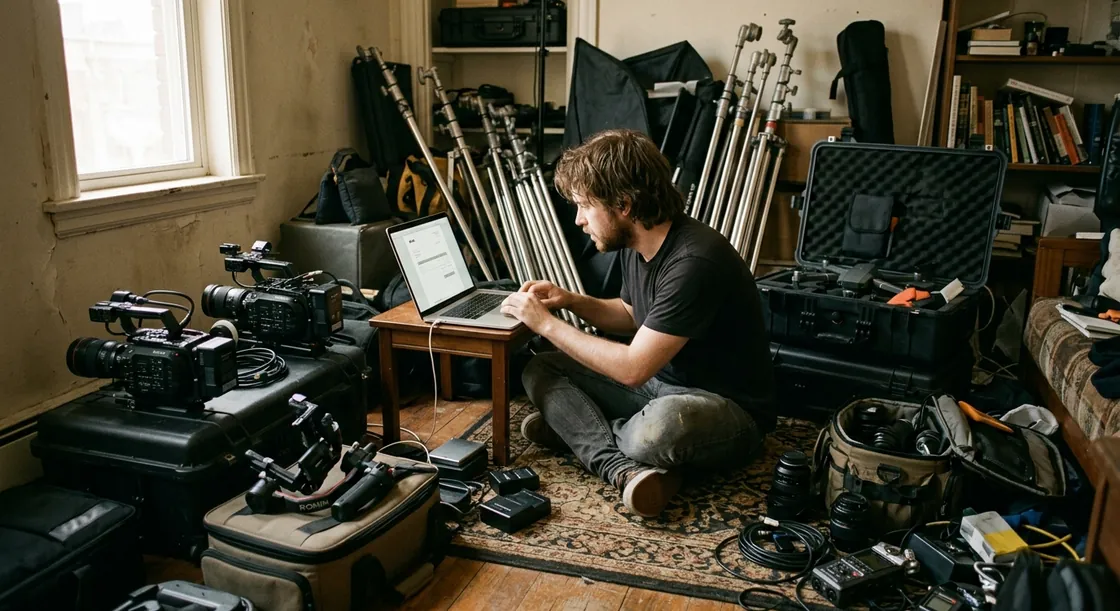
Someone asks a version of this every fall, in every freelancer forum. I formed an LLC. I have one client. I made a thousand dollars this year, and I bought ten thousand dollars of camera gear. Can I write all of it off?
The answer is yes, no, and it depends — in that order. And it usually arrives with the LLC mentioned early, as though the LLC were the thing that made the deduction possible. It isn’t, and almost everything else follows from clearing that up first.
The LLC does nothing here
A single-member LLC is a disregarded entity for federal income tax. The IRS looks straight through it. Your income and expenses land on Schedule C of your personal return, exactly as they would if you had never filed anything with the state.
The LLC is doing real work — it separates business liabilities from your personal assets, which is why people form one. But it does not create deductions, it does not change which deductions you qualify for, and it does not make a questionable expense defensible. A camera bought by your LLC and a camera bought by you are the same camera on the same Schedule C.

So when the question is “can my LLC write off $10,000 of gear against $1,000 of income”, you can delete the LLC from the sentence and the answer stays the same.
Two ways to deduct gear in year one
There are two ways a self-employed person can deduct equipment in the year it goes into use, instead of spreading the cost over several years of depreciation.
Section 179 expensing lets you elect to deduct the cost of qualifying property in the year it is placed in service. For 2026 the cap is $2,560,000, with a separate $32,000 limit for sport utility vehicles. Those numbers will never touch a one-person business, which is why so much writing about Section 179 is useless to you: it leads with the ceiling you cannot reach.
The limit that does bite is a different one. Section 179 cannot exceed your taxable income from the active conduct of a trade or business — and that total includes any wages you earned as an employee, and your spouse’s too if you file jointly. So the answer depends on the rest of your return:
- If the $1,000 is your only income, Section 179 is capped at about $1,000. The unused amount is not lost — it carries forward to a year with income to absorb it — but it cannot create a loss this year.
- If you also have a $60,000 day job, the cap is roughly $61,000, and the whole $10,000 fits under it.
Bonus depreciation works differently. For eligible property acquired after January 19, 2025, the 2025 tax law made it a permanent 100%. It has no dollar cap and, critically, no business income limit at all. Bonus depreciation can create a net operating loss.

Which means the mechanical answer to the question is yes. Ten thousand dollars of eligible gear, 100% bonus depreciation, a thousand dollars of revenue, and you have produced a loss of roughly nine thousand dollars that can reduce your other income — your salary, your spouse’s income, whatever else is on the return.
That is where most articles stop. For camera gear, there are two more rules before the answer means anything.
The rule written for camera gear
The IRS has a category called listed property: things that lend themselves to personal use. It includes cars, and it explicitly includes photographic, phonographic, communication and video recording equipment — unless that equipment is used exclusively in your business or at your regular business establishment.
That exception matters, because listed property comes with a hard rule: if business use is 50% or less, it gets neither Section 179 nor bonus depreciation. You are left with ordinary depreciation spread over years, on the business share only. And if business use starts above 50% and later drops to 50% or less, the extra deduction you took up front comes back as income.
A camera that shoots two paid jobs and your sister’s wedding is not exclusively business equipment. A camera that sits in the closet between those two jobs and goes on vacation with you may not be majority business equipment either. The percentage is the whole question, and “about 70%” is a guess you will struggle to defend. A log is not a guess.
The rule that actually decides it
Section 183 covers “activities not engaged in for profit” — the hobby loss rules. If your activity is a hobby rather than a business, the losses are not reduced. They are disallowed.
This used to be softer. Before 2018 you could at least claim hobby expenses as a miscellaneous itemized deduction above a 2% floor. That deduction was suspended, so a hobby finding today mostly deletes the deduction while leaving the income taxable.
There is a safe harbor. If the activity shows a net profit in three of five consecutive years, the law presumes it is engaged in for profit, and the burden shifts to the IRS to show otherwise. The profit does not have to be large. A dollar counts.
Falling short of that decides nothing on its own. Failing the presumption does not make you a hobby — it just takes away the tailwind. What follows is a nine-factor, facts-and-circumstances test from the Treasury regulations.
What the nine factors are really asking
Reduced to the question behind them: does this look like someone trying to make money, or someone funding an interest?
The factors that tend to help you:
- You run it like a business. A separate bank account, books that exist, numbered invoices, a sense of what things cost.
- You put real time and effort in.
- You have relevant expertise, or you took advice from someone who does.
- It is early. Startup losses are expected; an activity in its first few years gets more room than one that has lost money for a decade.
- There is a plausible path to profit, and you changed your methods when something did not work.

The factors that tend to hurt:
- The activity is personally enjoyable and the assets are things people want to own anyway. This is the one that catches photographers, musicians and anyone whose business runs on equipment they would happily keep at home.
- The losses are large, repeated and tied to no plan.
- You have substantial other income that the losses conveniently offset.
Now hold the original question against that list. One client. A thousand dollars of revenue. Ten thousand dollars of camera equipment, personally desirable, in a field people pursue for love. If that is year one of a real business with a plan, records and effort behind it, it is defensible, and startup losses are normal. If it is a nice camera with an LLC wrapped around it, it is the textbook shape of the thing Section 183 exists to catch.
Nobody can tell which one yours is from the numbers alone. That is the honest answer, and it is also the useful one: the deduction is decided by facts you create during the year, not by a box you tick in April.
A write-off is not a discount
A deduction reduces your taxable income, not your tax bill. What it gives back is your marginal rate. For a self-employed person that rate is higher than people expect — income tax plus 15.3% self-employment tax on most of your profit — but it is still a fraction, never the whole.
Spend $1,000 on something you need and the deduction softens it. Spend $1,000 on something you do not need to avoid $300 of tax, and you are $700 poorer with a thing you did not want. The deduction is a discount on a purchase you were going to make anyway. It is not a reason to make one.
The rule that probably applies to you instead
Here is the part almost nobody writing about Section 179 mentions, and it is the one most self-employed people actually need.
The de minimis safe harbor lets you deduct property costing $2,500 or less per item or invoice as an ordinary business expense, with no depreciation schedule. A $900 laptop, a $1,400 lens, a $600 desk — none of them needs Section 179 or bonus depreciation. Most self-employed equipment buying never leaves this lane.
Two conditions, because it is an election rather than an automatic rule:
- You attach a short statement to your return, titled “Section 1.263(a)-1(f) de minimis safe harbor election”, with your name, address and taxpayer ID, on a timely filed original return (extensions count). It is made one year at a time.
- Your books have to treat those items as expenses, under a consistent policy you already had at the start of the year. It does not need to be written down unless you have audited financial statements.
If you have audited financial statements the limit is $5,000. If you are reading this, you almost certainly do not.
The timing rule that catches people
The phrase is placed in service. Not ordered, not paid for, not invoiced — ready and available for use.
Equipment has to be bought and actually in use by December 31 to count for this year. Order a body on December 30 that arrives on January 6, and it is a next-year deduction whatever the invoice date says. If you are making a December purchase for tax reasons, the delivery date is the one that matters.
So what should you actually do

If you need the gear and the business is real, buy it when you need it, make sure it is in service by December 31, and record the business-use percentage honestly as you go. For most purchases that means the de minimis election and no depreciation forms at all.
If the gear is camera, audio or video equipment that also has a personal life, find out whether it clears 50% business use before you plan around Section 179 or bonus depreciation. Below that line, neither is available.
If the gear substantially outweighs what the business has earned, the question is no longer which code section applies. It is whether you can show a profit motive: books, a plan, effort, and a believable route to making money. Build that during the year and the deduction looks like what it is. Build nothing and reach for it in April, and you are asking an accountant to construct a story after the fact.
And if you are buying mainly to cut your tax bill, stop. You are spending a dollar to save a fraction of one.
How BrassWell fits
Most of what decides this question is record-keeping: income and expenses kept separate and current, receipts attached to the purchases they prove, and a tax set-aside that updates every time money comes in. That is what this app does — receipts read straight into the expenses they belong to (Pro keeps the photos too), and a set-aside worked out as a percentage of your profit, updated with every entry.
It will not tell you whether your activity is a business, and it does not track business-use percentages for equipment. What it can do is make sure that when you sit down with someone to work it out, a year of numbers is already in one place.
Where this stops
Whether an activity is a business or a hobby is decided on the facts of one particular situation, which is why this page can explain the test and cannot give you your answer. Depreciation also has more moving parts than fit here — state conformity, the choice to elect out of bonus depreciation, and how a loss carries to other years among them. If the numbers are large, get an opinion from someone who can see your whole return before you file.
Questions, answered
Can I deduct more than I earned from my business?
Sometimes. Bonus depreciation has no business-income limit, so eligible equipment can produce a loss that reduces your other income. Section 179 is different: it is capped at your taxable income from any business you actively run plus any wages you earned as an employee, and your spouse’s on a joint return, with the excess carried forward. Whether a loss survives at all is a separate question under the hobby-loss rules of Section 183.
Does forming an LLC let me deduct more?
No. A single-member LLC is a disregarded entity for federal income tax, so its income and expenses go on Schedule C of your personal return exactly as they would without it. The LLC is a liability shield. It does not create deductions or make a questionable one easier to defend.
Can I use Section 179 or bonus depreciation on a camera I also use personally?
Only if business use is more than 50%. Photographic, phonographic, communication and video recording equipment is listed property unless it is used exclusively in your business or at your regular business establishment, and listed property used 50% or less for business qualifies for neither Section 179 nor the special depreciation allowance. If business use later drops to 50% or less, the extra deduction is recaptured as income.
What happens if I do not make a profit in three of five years?
Nothing is decided automatically. Profit in three of five consecutive years raises a presumption that the activity is engaged in for profit; missing it only removes the presumption. The question then goes to a facts-and-circumstances test with nine factors, including how businesslike the activity is, the time you put in, your expertise, your history of income or losses, and whether there is a personal-pleasure element.
Do I need Section 179 for a $1,200 laptop?
Usually not. The de minimis safe harbor lets you deduct items costing $2,500 or less per item or invoice as an ordinary expense. It is an annual election: you attach a statement titled “Section 1.263(a)-1(f) de minimis safe harbor election” to a timely filed return, and your books must treat those items as expenses under a policy in place at the start of the year.
I bought equipment in December but it arrived in January. Which year is the deduction?
Next year. Depreciation and Section 179 start when property is placed in service, meaning ready and available for its intended use, not when it was ordered or paid for. Equipment that arrives in January is placed in service in January.
Sources
- Single member limited liability companies — IRS. A single-member LLC is disregarded as separate from its owner for income tax, so its activity is reported on the owner’s return.
- Instructions for Form 4562, Depreciation and Amortization — IRS. The Section 179 business income limit on line 11, including wages and a spouse’s income on a joint return; the listed-property definition naming photographic and video equipment; and the more-than-50% business-use rule.
- Publication 946, How To Depreciate Property — IRS. The 2026 Section 179 limits — $2,560,000, the $4,090,000 phase-out and the $32,000 SUV limit — plus placed-in-service rules and the 100% allowance for property acquired after January 19, 2025.
- Treasury, IRS issue guidance on the additional first year depreciation deduction — IRS. Notice 2026-11 on the permanent 100% special depreciation allowance, including interim reliance on the existing regulations.
- Tangible property final regulations — IRS. The $2,500 per item or invoice de minimis safe harbor, the $5,000 limit with an applicable financial statement, and how to make the election.
- 26 U.S. Code § 183, Activities not engaged in for profit — Legal Information Institute. The hobby-loss rule itself, and the presumption in subsection (d) for activities with a profit in three of five consecutive years.
- 26 CFR § 1.183-2, Activity not engaged in for profit defined — Legal Information Institute. The nine factors used to decide whether an activity is engaged in for profit.