


A profit and loss statement — a P&L, or income statement — answers one question: over this period, did the business make money, and how much? Income minus expenses equals net profit. It is what a landlord, a lender or your accountant asks for, and you can read one properly in five minutes. Below is a real one, line by line, and then the three taps that produce your own in BrassWell.
A real P&L, top to bottom
Here is a quarterly P&L for a sample design studio, exactly as BrassWell produces it. We will use its numbers throughout.
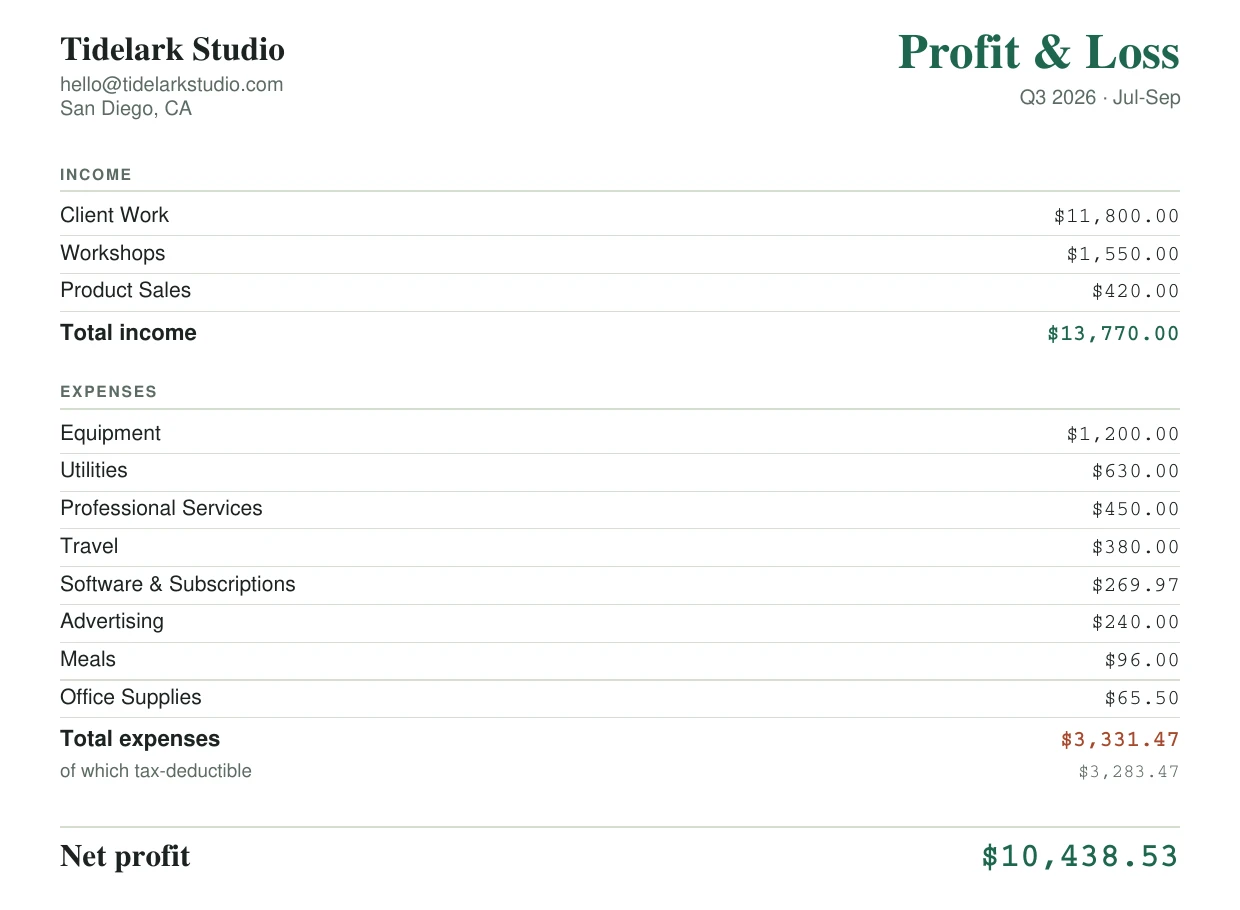
Three blocks: the header (business and period), income by category ($13,770), and expenses by category, largest first ($3,331.47, of which $3,283.47 is tax-deductible — only half of business meals count). Under it all, net profit: $10,438.53.
The five-minute read
1. Period and basis. Confirm the dates. Then the basis: BrassWell’s says cash basis, meaning amounts count when money actually moved. Most one-person businesses keep their books this way.
2. Does income match your gut? If total income is far from what you remember being paid, a payment is missing or doubled in your records. Fix that before anyone else sees it.
3. The biggest expenses. Read the top three and ask if any surprise you. Here, $1,200 of equipment is a one-off camera body, so this quarter’s profit understates a normal month. Also look for what is missing, like a monthly subscription that only appears twice.
4. Net profit and margin. Divide net profit by income: $10,438.53 ÷ $13,770 is a 76% margin. Service businesses with few costs often run high margins; a bakery or a reseller runs far lower. Compare against your own margin over time: if it slides from 76% to 60% across a year, costs are outgrowing income, and the P&L told you before your bank balance did.
5. What it means for tax. Self-employment tax alone on this quarter is about $1,475 (15.3% of 92.35% of profit), before income tax. If your set-aside is well short of that, you have found the gap in time. This guide works out the full figure.
Do this once a quarter, ideally a week before each estimated tax payment is due, and compare each quarter with the one before. Five minutes, four times a year, and you will know more about your business than most people who own one.
What a P&L does not tell you
- Your cash. Tax set-asides and savings sit in your accounts but not on the P&L.
- Your pay. Money a sole proprietor moves to their own account is an owner’s draw, not an expense.
- Unpaid invoices and bills. On a cash basis they do not count until money moves.
- Your tax deduction for big purchases. That can differ from the P&L; see writing off more than you earned.
Who asks for one

Landlords want proof that income covers rent, usually for the last three to twelve months. Lenders look at profit, not revenue; some accept a P&L you prepared, others require a CPA, so ask first. Your accountant uses it to start your Schedule C. Whoever asks, send a PDF for exactly the period they want, with your business name on it. BrassWell’s statement notes in its footer that it comes from your own bookkeeping and is not audited, which is the honest description and what most landlords expect.
Getting your P&L in BrassWell
If your income and expenses are in BrassWell, the P&L is already built. 1. Open the Taxes tab.

2. Choose a period on the Profit & Loss card: This year, Last year, Quarter, Last 3 months or Custom. The net shows on the card straight away.
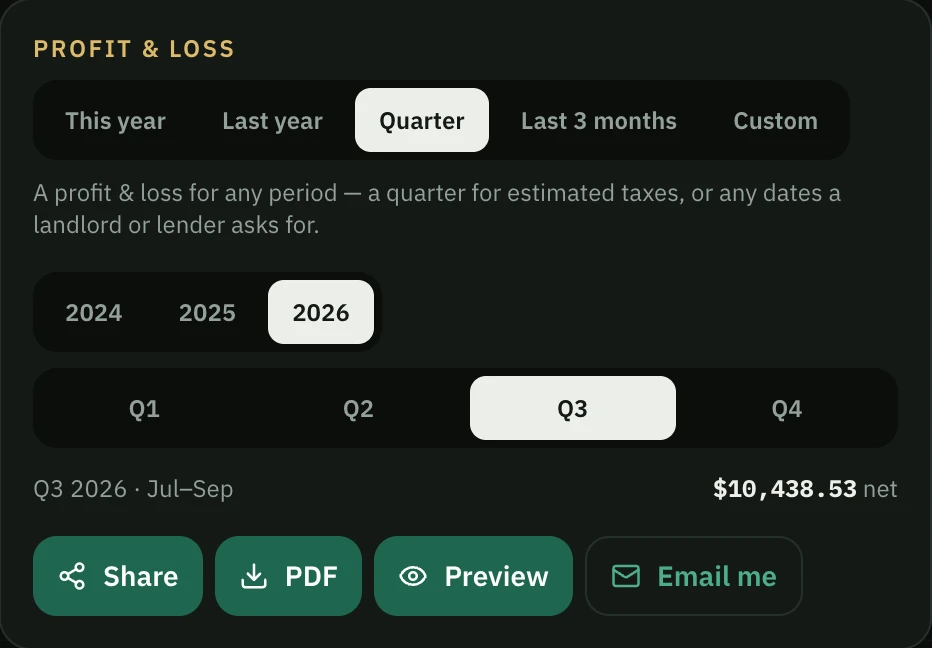
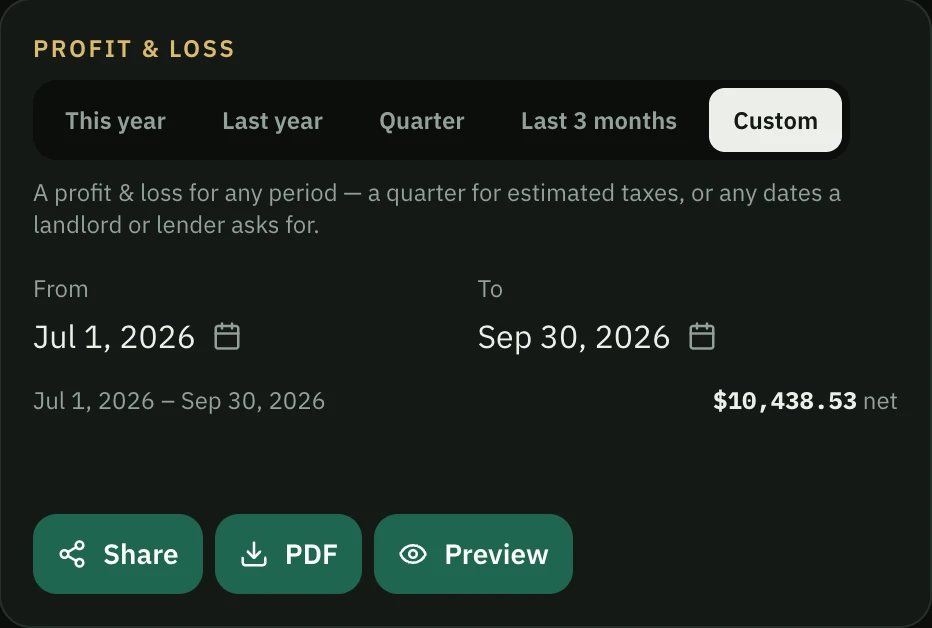
3. Preview, download or share it. On Pro, the Quarter view also has Email me. For a landlord’s own window, choose Custom.
BrassWell includes only business expenses, leaves out entries you marked as ignored, and shows refunds on their own line. The statement is only as complete as your records, so ten minutes a week logging receipts is what makes the five-minute read worth doing.
Questions, answered
What is a profit and loss statement?
A profit and loss statement, or P&L, shows a business’s income and expenses over a specific period and the net profit or loss that results. It is also called an income statement.
How do you calculate profit margin from a P&L?
Divide net profit by total income. A business with $13,770 of income and $10,438.53 of net profit has a profit margin of about 76%.
Is a P&L the same as cash in the bank?
No. A P&L shows profit over a period. Your bank balance also reflects money you set aside, owner’s draws, loans and timing, none of which change profit.
Can I use a P&L I made myself for a landlord or lender?
Often for a landlord. Lenders vary: some accept a self-prepared P&L with your tax returns, and others require one prepared or reviewed by a CPA. Ask before you send it.
How do I get a P&L in BrassWell?
Open the Taxes tab, choose a period on the Profit & Loss card (this year, last year, a quarter, the last three months or custom dates), then tap Preview, PDF or Share. On Pro, the quarter view can also email the quarterly statement to you.
Sources
- Self-employment tax (Social Security and Medicare taxes) — IRS. The 15.3% rate on 92.35% of net earnings used in the tax step.
- Publication 538, Accounting Periods and Methods — IRS. The cash and accrual methods of accounting.
- About Schedule C (Form 1040) — IRS. Where a sole proprietor reports business profit or loss.